
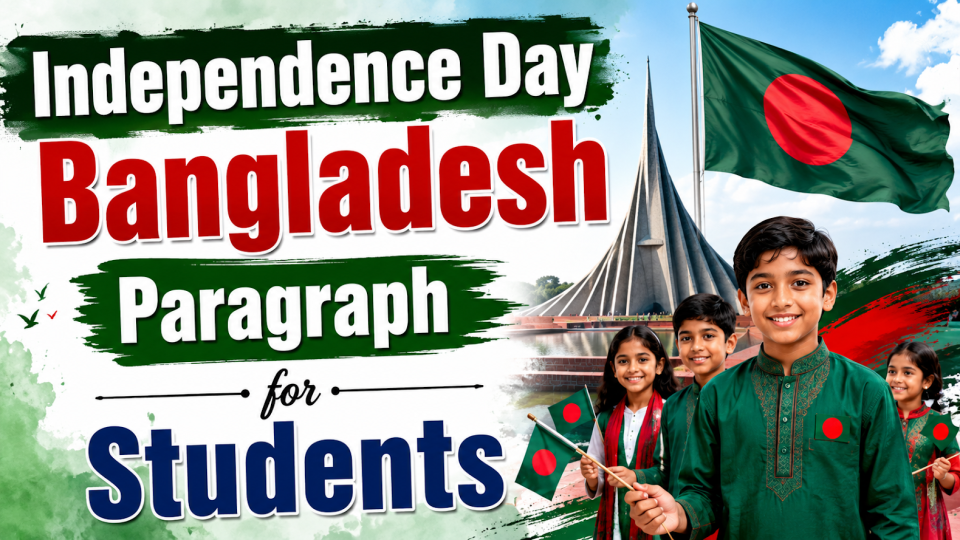
Most of the countries located on the eastern side of the world have had a colonial past. History states that they have had to fight to get freedom from their ruthless colonial masters. That is not all. Apart from their colonial rulers, there were multiple internal strifes and border issues that they also had to deal with. It took immense time, patience, and commitment to get rid of all the economic and social issues and finally celebrate the day by defining oneself and reinstating one’s identity. When you have to write a paragraph on Independence Day, you must mention the history behind the independence struggle, the heroes who laid down their lives for the country, and the way the day is celebrated throughout the country.
Independence Day Paragraph for Class 6 to 8 (150 Words)
For countries with a colonial past, their Independence Day is a mighty affair. On this day, they got back their freedom and their power as citizens of the country to call their nation their own. It is on this day that they got the rights of a citizen and could proudly tell the world that they were no longer under the colonial masters.
Talking about Bangladesh, formally, its Independence Day is on the 26th of March. It was on March 26, 1971, that Bangladesh, after a long fight, got its independence from Pakistan. This historical incident was followed by the MuktiJuddho of Bangladesh, which is referred to as Victory Day. The country commemorates this day as a national holiday. Also, Bangladesh is the only country in the world where the basis of the independence movement was the proliferation of the language, the mother tongue of Bangladesh – Bengali. It is due to the constant suppression of the Bengali language, along with other social and economic factors, that led to the independence movement by the people of Bangladesh.
Paragraph for Independence Day celebration (200 Words)
Independence Day is celebrated on the day the country gained freedom from foreign powers. On that day, the national flag is flown over the government buildings. Multiple activities are held throughout the day, such as flag-hoisting ceremonies, multiple state-related occasions, and parades. Apart from that, people who have laid their lives down for the country are honoured as well.
The Independence Day of Bangladesh is celebrated on March 26, 1971. On this day, the British created East Bengal or East Pakistan (as referred to officially) and gained independence from Pakistan. This was followed by the MuktiJuddho, which is referred to as Victory Day (16th December 1971). This date is also referred to as Vijay Diwas in India.
On this day, the country celebrates its independence and honours the leading heroes of the country who laid down their lives for Bangladesh. From the government to schools, colleges and every other institution celebrates this day with much fanfare.
Independence Day Paragraph for Class 9 to 10 (250 Words)
Back in the 1800’s, the Western powers, especially the British and other colonial powers, had captured and ruled numerous countries. Most of those countries got their freedom in the latter part of the 1900s. Those countries that got their freedom celebrate the ‘particular day’ that it was granted as the Independence Day of the country.
For Bangladesh, that date is the 26th of March, 1971. It is celebrated in Bangladesh as a national holiday.
Let us get into the history behind Bangladesh’s independence –
The British completely captured India after the Battle of Plassey in 1757. At that time, Bangladesh was part of India and it was referred to as ‘Bengal’ in general. In 1905, the British partitioned Bengal into East Bengal (the current Bangladesh portion) and West Bengal. Finally, in 1947, when India was divided into India (Hindustan) and Pakistan, the East Bengal portion went to Pakistan, due to its Muslim majority.
In 1947, a group called the Inner Group was formed to help in the freedom process and fight the Britishers. The primary problem that arose for East Bengal was that Jinnah, Pakistan’s President wanted to impose Urdu as the national language even in the eastern part of Bengal (after division). However, Bengali was the mother tongue of the people of East Bengal. Also, culturally, the people of East Bengal, despite their Muslim majority, were similar to the people of West Bengal. Hence, they vehemently opposed the move to change their language and alter the essence of their part of the country.
Taking all this into stride, the members of the Bengal Provincial Muslim League followed the ideologies of Subhas Chandra Bose and Mujibur Rahman (the then primary leader of Bangladesh’s freedom movement, and is referred to as the Father of Bangladesh), who put forth the idea of engaging in an armed struggle.
At the end of the day, what happened was that Mujibur Rahman kept fighting for the independence of Bangladesh from Jinnah-ruled Pakistan. In fact, during this whole period, Rahman sought active help from Nehru to the extent of discussing the government-in-exile.
Mujibur Rahman led the Awami League party and demanded the freedom of East Bengal from Pakistan with his 6-Point Programme. When the elections were held, the Awami League won with a massive majority, but was not allowed to form the government. But later, he did get to form the government, only to be faced with another 9-month-long war.
During the tough period of 1971, he also took help from Smt. Indira Gandhi, the then Indian PM to fight Pakistan. This fight was followed by one for a second independence, which is termed Muktijuddho or Victory Day.
Finally, on March 26, 1971, Mujibur Rahman declared the independence of Bangladesh on the radio, while Operation Searchlight was on. While Mujibur Rahman was placed in jail, Major Ziaur Rahman, who was the then officer of the East Bengal Regiment, declared independence formally from the Swadhin Bangla Betar Kendra. That is how Bangladesh gained independence.
Independence Day Paragraph for HSC (300 Words)
Independence Day is one of the most significant national days in Bangladesh. It is observed on 26 March every year, marking the declaration of independence from Pakistan in 1971. This day reminds the people of Bangladesh of their long and heroic struggle for freedom, which eventually led to the birth of an independent nation after a bloody Liberation War.
The journey toward independence began after the partition of India in 1947, when East Bengal became East Pakistan. However, political discrimination, economic exploitation, and cultural suppression by West Pakistan created strong dissatisfaction among the people of East Pakistan. The demand for autonomy gradually turned into a movement for full independence. The historic election of 1970, where the Awami League won a majority, but power was not transferred, further increased tension.
On the night of 25 March 1971, the Pakistani army launched Operation Searchlight, attacking innocent civilians, students, and intellectuals. In response, the declaration of independence was made, and the Liberation War officially began. Under the leadership of Bangabandhu Sheikh Mujibur Rahman, and with the participation of freedom fighters known as “Muktijoddhas,” the people of Bangladesh fought bravely for nine months. Finally, on 16 December 1971, Bangladesh achieved victory and became an independent nation.
Independence Day is observed with great respect and national pride. The day begins with the hoisting of the national flag, wreath-laying at the National Martyrs’ Memorial, and special prayers for the martyrs. Schools, colleges, and cultural organizations arrange various programs highlighting the significance of the Liberation War.
This day is not only a celebration but also a reminder of sacrifice, courage, and unity. It teaches the younger generation to respect freedom and contribute to the development of the country. Independence Day inspires every citizen of Bangladesh to work for peace, progress, and national harmony.
Conclusion
In conclusion, the Independence Day Paragraph highlights the historic struggle, sacrifice, and victory of Bangladesh in 1971. Independence Day of Bangladesh reminds us of the courage of the people who fought for freedom and built an independent nation. This day inspires every citizen to value unity, liberty, and national pride. It also encourages the younger generation to learn about the Liberation War and contribute to building a stronger, peaceful, and progressive Bangladesh for the future.
FAQs on Independence Day of Bangladesh
Q1. When is Independence Day of Bangladesh celebrated?
The Independence Day of Bangladesh is celebrated on 26 March every year. It marks the country’s declaration of independence in 1971.
Q2. Why is 26 March important for Bangladesh?
This date is important because it represents the beginning of the freedom struggle of Bangladesh against Pakistan, leading to the Liberation War.
Q3. What is MuktiJuddho?
MuktiJuddho refers to the Liberation War of Bangladesh in 1971, which resulted in the country gaining independence after a long struggle.
Q4. How is Independence Day celebrated in Bangladesh?
It is celebrated with flag hoisting, parades, cultural programs, tributes to freedom fighters, and national ceremonies across the country.
Q5. Who are the key figures in Bangladesh’s independence movement?
Sheikh Mujibur Rahman is considered the central leader of the independence movement, along with countless freedom fighters who played a major role in the Liberation War.
